Ambien Overdose Treatment: Emergency Signs and What Happens at a Detox Facility
Key Takeaways:
- An Ambien overdose is a medical emergency, call 911 immediately if someone is unresponsive, confused, or having trouble breathing
- Ambien acts on the brain similarly to benzodiazepines, and overdose suppresses breathing and heart function
- Combining Ambien with alcohol, opioids, or other sedatives dramatically increases overdose risk
- Emergency room treatment focuses on stabilizing breathing and vital signs, it does not address the underlying dependency
- After medical stabilization, supervised detox at a facility like Pacific View Detox provides the structured support needed to break the cycle safely
- Pacific View Detox in Dana Point, California specializes in medically supervised withdrawal from Ambien and related sedative medications, call 1-888-599-8382
Ambien Overdose Treatment: Emergency Signs and What Happens at a Detox Facility
Someone finds their family member unresponsive in bed. An empty pill bottle is nearby. There is shallow breathing, no response to voice, and no idea how many pills were taken. This is an Ambien overdose, and it requires an emergency call to 911 without hesitation.
Ambien is prescribed more than 10 million times each year in the United States. Most people taking it have a legitimate sleep disorder and are following their doctor’s instructions. But Ambien is also one of the most commonly misused prescription sleep aids in the country, and its potential for overdose is real, especially when mixed with alcohol, opioids, or other sedatives.
If someone you care about is struggling with Ambien use, Pacific View Detox in Dana Point, California offers confidential assessments and medically supervised care for specialized Ambien addiction treatment.
What Is Ambien and Why Can It Lead to Overdose?

Despite being structurally different from benzodiazepines, Ambien acts on the same GABA receptors and produces very similar effects, including sedation, relaxation, and at higher doses, respiratory depression. This is why Ambien dependency and overdose patterns closely resemble those seen with benzos.
Ambien is typically prescribed at 5 mg to 10 mg per dose for short-term use. Doses above that threshold increase the risk of side effects significantly. Daily use for even a few weeks can create physical dependence, meaning the brain adapts to the drug’s presence and begins to require it to function normally. Once dependence develops, the risk of escalating doses, and overdose, rises substantially.
Emergency Signs
Recognizing an overdose quickly can be the difference between recovery and irreversible harm. The signs range from severe to life-threatening and can escalate rapidly, particularly if the person has combined Ambien with other substances.
Overdose Symptoms by Severity
| Severity Level | Symptoms to Watch For |
|---|---|
| Moderate | Extreme drowsiness, confusion, slurred speech, loss of coordination, memory blackouts |
| Severe | Slowed or irregular breathing, very low heart rate, chest pain, inability to stay conscious |
| Critical / Emergency |
Unresponsiveness, coma, respiratory failure, cardiovascular collapse |
The most dangerous overdose symptoms are those affecting breathing and heart function. Ambien suppresses central nervous system activity, and in high doses, that suppression extends to the systems that regulate respiration. A person in respiratory depression may appear to be sleeping deeply, but they are not getting enough oxygen. Brain damage can begin within minutes.
Call 911 immediately if any of the following are present:
- The person cannot be woken up or responds only minimally
- Breathing is slow, shallow, irregular, or has stopped
- Lips or fingernails are turning blue or gray
- The person is making gurgling or choking sounds
- Heart rate is abnormally slow or irregular
- The person is in or appears to be entering a coma
What Increases the Risk of a Sleeping Pill Overdose?
Not every person who takes Ambien is at equal risk. Several factors increase the likelihood of a sleeping pill overdose, and understanding them helps with both prevention and recognition.
Factors That Increase Risk
| Risk Factor | Why It Matters |
|---|---|
| Combining with alcohol | Both suppress CNS activity; together, the effect on breathing is multiplicative, not additive |
| Combining with opioids | Creates synergistic respiratory depression, one of the most dangerous drug combinations |
| Combining with other sedatives or benzos | Amplifies CNS suppression beyond safe levels |
| Taking more than the prescribed dose | Higher doses overwhelm the body’s ability to metabolize the drug safely |
| Older age (65+) | Slower metabolism means the drug stays in the system longer and accumulates |
| History of substance misuse | Higher likelihood of dose escalation or poly-substance use |
| Female sex | Research shows women metabolize zolpidem more slowly than men, leading to higher blood concentrations from the same dose |
| Liver impairment | The liver processes Ambien; compromised liver function significantly slows clearance |
| Mental health crises | Intentional overdose risk is elevated in individuals with depression or acute psychological distress |
One pattern that comes up repeatedly in clinical settings is Ambien combined with alcohol. Both suppress the same brain systems. Taking a normal Ambien dose after drinking, even a moderate amount, can push breathing into dangerous territory.
What Happens in the Emergency Room?
When someone arrives at an emergency room with a suspected Ambien overdose, treatment focuses on stabilizing vital signs. There is no specific antidote for zolpidem overdose in the way naloxone reverses opioid toxicity, though flumazenil, a drug that blocks GABA receptor activity, is sometimes used in cases involving combined benzo or Z-drug exposure.
Standard emergency interventions include:
- Monitoring and supporting breathing, including oxygen supplementation or mechanical ventilation if respiratory depression is severe
- IV access and fluids to support blood pressure and circulation
- Cardiac monitoring for heart rate and rhythm abnormalities
- Activated charcoal in some cases, if the overdose is recent and the person is conscious enough to swallow safely
- Toxicology screening to identify any other substances involved
- Neurological observation to assess consciousness level and track changes
The ER team will stabilize the person and keep them under observation until vital signs normalize. In mild to moderate overdose cases without additional substances involved, patients may recover within several hours. Severe cases involving respiratory failure or coma require intensive care.
It is worth noting what the emergency room does not do: it does not treat the underlying dependency or the behavioral patterns that led to the overdose. That step requires a different level of care.
Why Emergency Care Is Not Enough: The Case for Detox
Being discharged from the hospital after an Ambien overdose without any follow-up plan is not an uncommon outcome, and it is one of the primary reasons repeat overdoses occur.
The hospital addresses the medical emergency. It does not address why someone was taking dangerous levels of a sedative, what the dependency looks like, or what the withdrawal process requires. A person who leaves without a structured plan often returns to the same patterns within days.
Professional detox treatment at a supervised facility provides the bridge between emergency stabilization and actual recovery. It manages withdrawal safely, addresses the physical dependency, and begins the clinical work of understanding what is driving the substance use.
For Ambien specifically, abrupt discontinuation without medical supervision carries real risk. Withdrawal from sedative-hypnotics can include anxiety, insomnia, tremors, and in severe cases, seizures. The brain has adapted to the presence of Ambien, and removing it suddenly can trigger a rebound that is both physically dangerous and psychologically overwhelming. This is not something to manage alone.
Get Safe, Professional Ambien Detox Now
Don’t face Ambien withdrawal alone. Pacific View Detox offers 24/7 medically supervised care to help you recover safely. Contact our team today.
What Happens at a Detox Facility for Ambien?
At Pacific View Detox in Dana Point, California, Ambien detox follows a medically supervised protocol designed to manage withdrawal safely while beginning the clinical and therapeutic work of recovery.
Here is what the process typically looks like:
- Clinical intake and assessment, Upon arrival, a medical team reviews health history, current medications, the extent of Ambien use, and any co-occurring mental or physical health conditions. This shapes the individualized treatment plan.
- Medical stabilization, The treatment team manages withdrawal symptoms using evidence-based approaches, which may include gradual tapering of the medication rather than abrupt discontinuation. Around-the-clock medical monitoring is provided.
- Therapeutic engagement, As the patient stabilizes physically, therapy begins. Pacific View Detox integrates cognitive behavioral therapy (CBT), which has strong clinical evidence for addressing both insomnia and sedative dependency, alongside trauma-informed care and other evidence-based modalities.
- Dual diagnosis support, Many people using Ambien are managing an underlying anxiety disorder, depression, or chronic stress. Addressing only the Ambien use without treating what is driving it leaves the core problem unresolved. Pacific View Detox provides dual diagnosis evaluation and care.
- Discharge planning and continuing care, Detox is the beginning, not the end. The team at Pacific View coordinates referrals to intensive outpatient programs (IOP), partial hospitalization programs (PHP), or sober living arrangements through Maven Recovery Centers’ network, ensuring continuity of care.
Because Ambien acts on GABA receptors similarly to benzodiazepines, the clinical approach to Ambien withdrawal overlaps substantially with benzo detox protocols. Pacific View Detox’s benzo detox support infrastructure means the team is specifically equipped to handle sedative-hypnotic withdrawal safely and effectively.
Ambien Dependency vs. Ambien Misuse: Understanding the Difference
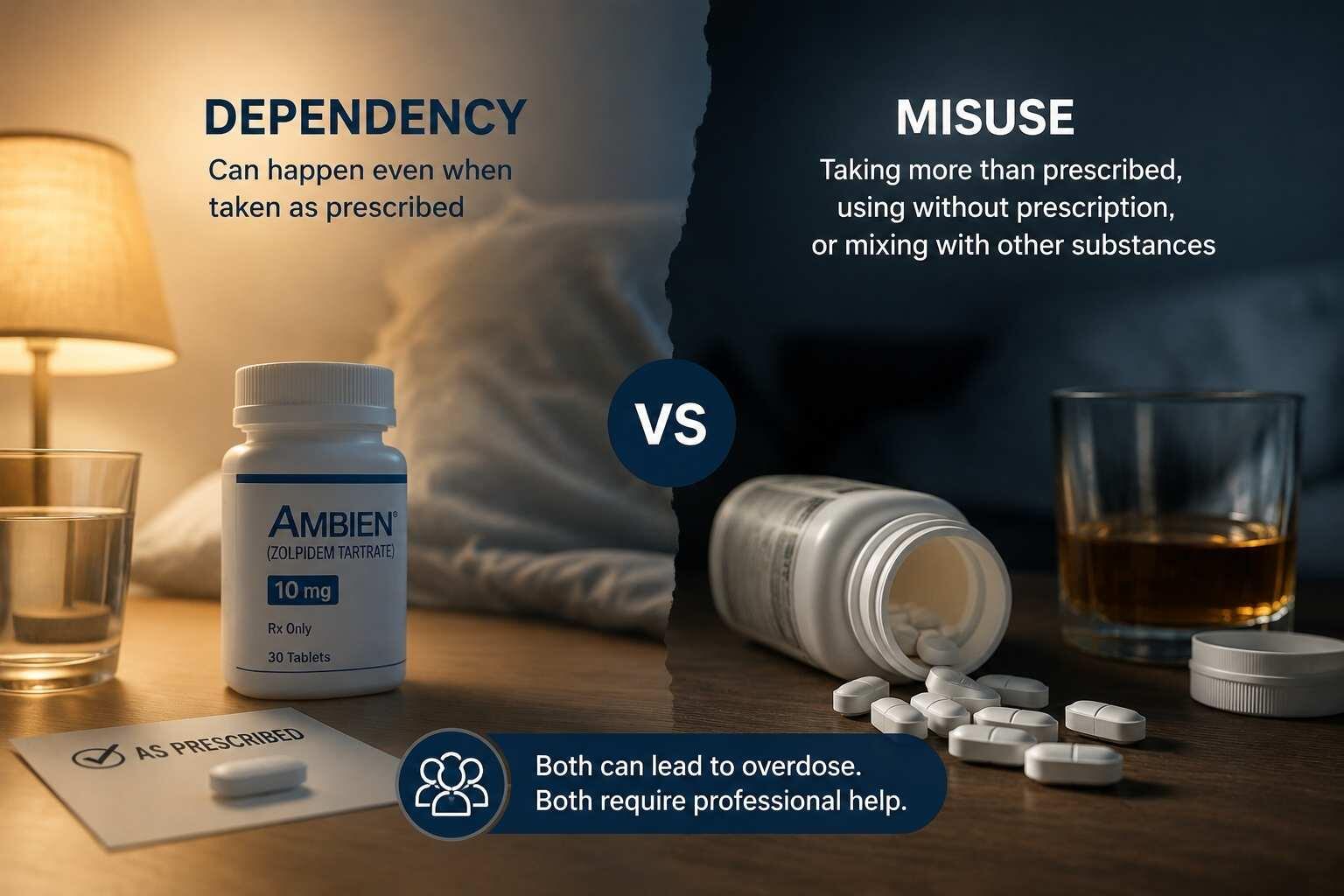
Not everyone who overdoses on Ambien was misusing it. Dependency can develop in people who are taking the medication exactly as prescribed, particularly if the prescription runs longer than the two to four weeks that most clinical guidelines recommend.
A person with dependency may gradually need higher doses to fall asleep, experience anxiety or insomnia when doses are missed, and feel unable to sleep at all without the medication. That is a medical reality of how the brain adapts to the drug, not a moral failure.
Misuse is a different pattern: taking more than prescribed, obtaining the medication outside a prescription, using it to get high or to enhance the effects of other drugs, or combining it knowingly with alcohol or other depressants. Both dependency and misuse can lead to overdose, and both require professional support to address safely.
Family members often struggle to distinguish between the two. If you are unsure whether what you are seeing in a loved one constitutes dependency, misuse, or something else, calling a treatment intake line is the right first step.
Treatment, Insurance, and Admissions at Pacific View Detox
Pacific View Detox is located at 34405 Via Gomez, Dana Point, California, serving individuals from Orange County, Los Angeles, San Diego, and throughout Southern California who need supervised medical detox for Ambien and related sedative medications.
The admissions process is straightforward:
- Call 1-888-599-8382 for a confidential intake conversation, available 24 hours a day
- An admissions counselor gathers basic information about the person’s situation and level of care needed
- Insurance verification is completed before any commitment is made, most PPO insurance plans cover medical detox, and the team will clearly explain what is and is not covered
- A clinical assessment determines the appropriate level of care and builds the initial treatment plan
- Admission is coordinated as quickly as possible, often the same day or the next day
Questions worth asking before admission: What does a typical day look like in the program? How long is the detox process expected to take? What happens after detox, is there a step-down care plan? Does my insurance cover the full program or just part of it?
The team at Pacific View Detox will answer all of these before you commit.
Guidance for Family Members
Watching someone you care about cycle through Ambien misuse, overdose, and emergency intervention is exhausting and frightening. Family members often carry enormous guilt, both for not recognizing the problem sooner and for not knowing how to help now.
A few practical things worth knowing:
You can call Pacific View Detox at 1-888-599-8382 on behalf of a loved one. You do not need the person’s consent to ask questions, gather information, or understand your options. That call is confidential and carries no obligation.
Do not try to manage Ambien withdrawal at home by reducing doses on a schedule without clinical guidance. Sedative-hypnotic withdrawal can turn dangerous without warning. The clinical team at Pacific View is trained specifically to handle this safely.
If your loved one has just been discharged from an emergency room after an Ambien overdose, that discharge moment is often the most important window for intervention. People are sometimes more willing to accept help in the hours immediately following a crisis than they will be days later. Acting quickly matters.
FAQ
{
“@context”: “https://schema.org”,
“@type”: “FAQPage”,
“mainEntity”: [
{
“@type”: “Question”,
“name”: “What are the signs of an Ambien overdose?”,
“acceptedAnswer”: {
“@type”: “Answer”,
“text”: “The most common signs include extreme drowsiness, confusion, slurred speech, slowed or irregular breathing, very low heart rate, and in severe cases, loss of consciousness or coma. Overdose symptoms tend to worsen rapidly, especially if Ambien was combined with alcohol or other depressants. Call 911 immediately if someone is unresponsive or having difficulty breathing.”
}
},
{
“@type”: “Question”,
“name”: “Can you overdose on Ambien if you take it as prescribed?”,
“acceptedAnswer”: {
“@type”: “Answer”,
“text”: “It is possible, particularly in older adults, people with liver conditions, women (who metabolize zolpidem more slowly), and those who combine it with even moderate amounts of alcohol. Prescribed doses are calibrated for average-risk patients under normal conditions. Any deviation from those conditions can shift the risk profile significantly.”
}
},
{
“@type”: “Question”,
“name”: “How is an overdose treated in the emergency room?”,
“acceptedAnswer”: {
“@type”: “Answer”,
“text”: “Emergency treatment is primarily supportive, stabilizing breathing, monitoring heart function, administering IV fluids, and observing the patient until vital signs normalize. In some cases, activated charcoal or flumazenil may be used. There is no dedicated antidote equivalent to naloxone for opioid overdose.”
}
},
{
“@type”: “Question”,
“name”: “What happens during Ambien detox at a facility?”,
“acceptedAnswer”: {
“@type”: “Answer”,
“text”: “Detox at a supervised facility like Pacific View Detox involves a clinical intake, individualized medical management of withdrawal (often including a gradual taper rather than abrupt discontinuation), 24-hour monitoring, therapy, and a continuing care plan. The goal is to make withdrawal as safe and manageable as possible while beginning the work of addressing the underlying dependency.”
}
},
{
“@type”: “Question”,
“name”: “Is Ambien withdrawal dangerous?”,
“acceptedAnswer”: {
“@type”: “Answer”,
“text”: “Yes, it can be. Withdrawal from sedative-hypnotics including Ambien can cause rebound insomnia, anxiety, tremors, and in severe cases, seizures. Attempting to stop Ambien abruptly after extended use, or after an overdose, without medical supervision carries real clinical risk. Supervised detox is the appropriate setting for this process.”
}
},
{
“@type”: “Question”,
“name”: “How is Ambien different from benzodiazepines like Xanax or Valium?”,
“acceptedAnswer”: {
“@type”: “Answer”,
“text”: “Ambien is structurally different from benzodiazepines but acts on the same GABA receptors in the brain, producing similar effects and carrying similar risks of dependence and withdrawal. It was originally marketed as having a lower addiction potential than benzos, but clinical experience and research have not supported that claim for people using it regularly.”
}
},
{
“@type”: “Question”,
“name”: “Does insurance cover Ambien detox treatment?”,
“acceptedAnswer”: {
“@type”: “Answer”,
“text”: “Most PPO insurance plans cover medically necessary detox for sedative-hypnotic dependency. Coverage specifics depend on the plan. Pacific View Detox verifies insurance before admission and walks patients and families through exactly what is covered.”
}
},
{
“@type”: “Question”,
“name”: “Can a family member call the facility on behalf of someone who needs help?”,
“acceptedAnswer”: {
“@type”: “Answer”,
“text”: “Yes. Family members are encouraged to call Pacific View Detox directly to ask questions, understand options, and get guidance on how to support a loved one through the decision to enter treatment. The call is confidential. No commitment is required.”
}
},
{
“@type”: “Question”,
“name”: “How long does Ambien detox take?”,
“acceptedAnswer”: {
“@type”: “Answer”,
“text”: “Acute detox for Ambien typically lasts one to two weeks, though this varies based on how long the person has been using, the dose, and their overall health. Some people experience lingering sleep disruption beyond the acute withdrawal phase. The clinical team will give a more specific estimate after the initial assessment.”
}
},
{
“@type”: “Question”,
“name”: “Is there an Ambien detox program near Orange County, California?”,
“acceptedAnswer”: {
“@type”: “Answer”,
“text”: “Pacific View Detox is located in Dana Point, California, within Orange County, and accepts patients from throughout Southern California including Los Angeles, San Diego, Laguna Niguel, San Clemente, Mission Viejo, and surrounding areas.”
}
}
]
}
What are the signs of an Ambien overdose?
The most common signs include extreme drowsiness, confusion, slurred speech, slowed or irregular breathing, very low heart rate, and in severe cases, loss of consciousness or coma. Overdose symptoms tend to worsen rapidly, especially if Ambien was combined with alcohol or other depressants. Call 911 immediately if someone is unresponsive or having difficulty breathing.
Can you overdose on Ambien if you take it as prescribed?
It is possible, particularly in older adults, people with liver conditions, women (who metabolize zolpidem more slowly), and those who combine it with even moderate amounts of alcohol. Prescribed doses are calibrated for average-risk patients under normal conditions. Any deviation from those conditions can shift the risk profile significantly.
How is an overdose treated in the emergency room?
Emergency treatment is primarily supportive, stabilizing breathing, monitoring heart function, administering IV fluids, and observing the patient until vital signs normalize. In some cases, activated charcoal or flumazenil may be used. There is no dedicated antidote equivalent to naloxone for opioid overdose.
What happens during Ambien detox at a facility?
Detox at a supervised facility like Pacific View Detox involves a clinical intake, individualized medical management of withdrawal (often including a gradual taper rather than abrupt discontinuation), 24-hour monitoring, therapy, and a continuing care plan. The goal is to make withdrawal as safe and manageable as possible while beginning the work of addressing the underlying dependency.
Is Ambien withdrawal dangerous?
Yes, it can be. Withdrawal from sedative-hypnotics including Ambien can cause rebound insomnia, anxiety, tremors, and in severe cases, seizures. Attempting to stop Ambien abruptly after extended use, or after an overdose, without medical supervision carries real clinical risk. Supervised detox is the appropriate setting for this process.
How is Ambien different from benzodiazepines like Xanax or Valium?
Ambien is structurally different from benzodiazepines but acts on the same GABA receptors in the brain, producing similar effects and carrying similar risks of dependence and withdrawal. It was originally marketed as having a lower addiction potential than benzos, but clinical experience and research have not supported that claim for people using it regularly.
Does insurance cover Ambien detox treatment?
Most PPO insurance plans cover medically necessary detox for sedative-hypnotic dependency. Coverage specifics depend on the plan. Pacific View Detox verifies insurance before admission and walks patients and families through exactly what is covered.
Can a family member call the facility on behalf of someone who needs help?
Yes. Family members are encouraged to call Pacific View Detox directly to ask questions, understand options, and get guidance on how to support a loved one through the decision to enter treatment. The call is confidential. No commitment is required.
How long does Ambien detox take?
Acute detox for Ambien typically lasts one to two weeks, though this varies based on how long the person has been using, the dose, and their overall health. Some people experience lingering sleep disruption beyond the acute withdrawal phase. The clinical team will give a more specific estimate after the initial assessment.
Is there an Ambien detox program near Orange County, California?
Pacific View Detox is located in Dana Point, California, within Orange County, and accepts patients from throughout Southern California including Los Angeles, San Diego, Laguna Niguel, San Clemente, Mission Viejo, and surrounding areas.
Getting Through This Requires More Than an Emergency Room Visit
An Ambien overdose gets someone stabilized. It does not get them well. The dependency that led to the overdose is still present when they walk out of the hospital, and without structured support, the cycle is likely to repeat.
Pacific View Detox, part of Maven Recovery Centers, provides the medically supervised environment needed to break that cycle safely. The facility in Dana Point, California treats Ambien dependency and sleeping pill overdose cases with individualized detox plans, dual diagnosis care, therapy, and a clear continuing care path. Most major insurance plans cover medical detox.
Confidential assessments are available now. Insurance can be verified before you commit to anything. Family support is part of the process.
Contact Pacific View Detox or call 1-888-599-8382 to speak with an admissions counselor today. The conversation is free, confidential, and available at any hour.
Medical Review Statement: This article is for educational purposes only and does not replace medical advice, diagnosis, emergency treatment, or care from a qualified health professional. If you suspect an Ambien overdose, call 911 immediately. This article should be reviewed by a qualified medical professional before publication.