Ambien Rehab Treatment: What a Full Recovery Plan Looks Like Beyond Detox
Key Takeaways:
- Ambien (zolpidem) is a sedative-hypnotic that can cause physical dependence even when taken as prescribed
- Detox addresses withdrawal symptoms but does not resolve the behavioral, emotional, or sleep-related aspects of dependence
- A full recovery plan typically includes therapy, sleep-hygiene support, mental health care, and relapse prevention
- Treatment timelines vary; recovery looks different for each person
- Pacific View Detox, part of Maven Recovery Centers in Dana Point, California, provides medically supervised detox and personalized treatment planning
- Insurance may cover some or all of treatment; confidential verification is available
What Is Ambien Dependence?
Ambien is the brand name for zolpidem, a sedative-hypnotic prescribed for short-term insomnia relief. It works by increasing the activity of GABA, a calming chemical in the brain, which slows activity in the nervous system and promotes sleep.
Physical dependence can develop even when Ambien is taken exactly as prescribed. The brain adapts to the presence of the drug. When the medication is reduced or stopped, the brain takes time to rebalance and that gap is where withdrawal symptoms appear.
Dependence, misuse, and substance use disorder are related but not the same thing. A person can become physically dependent without meeting the clinical criteria for a substance use disorder. Clinicians assess the full picture, including patterns of use, dose, duration, and the impact on daily functioning, before making recommendations.
Common signs that may indicate dependence or concern:
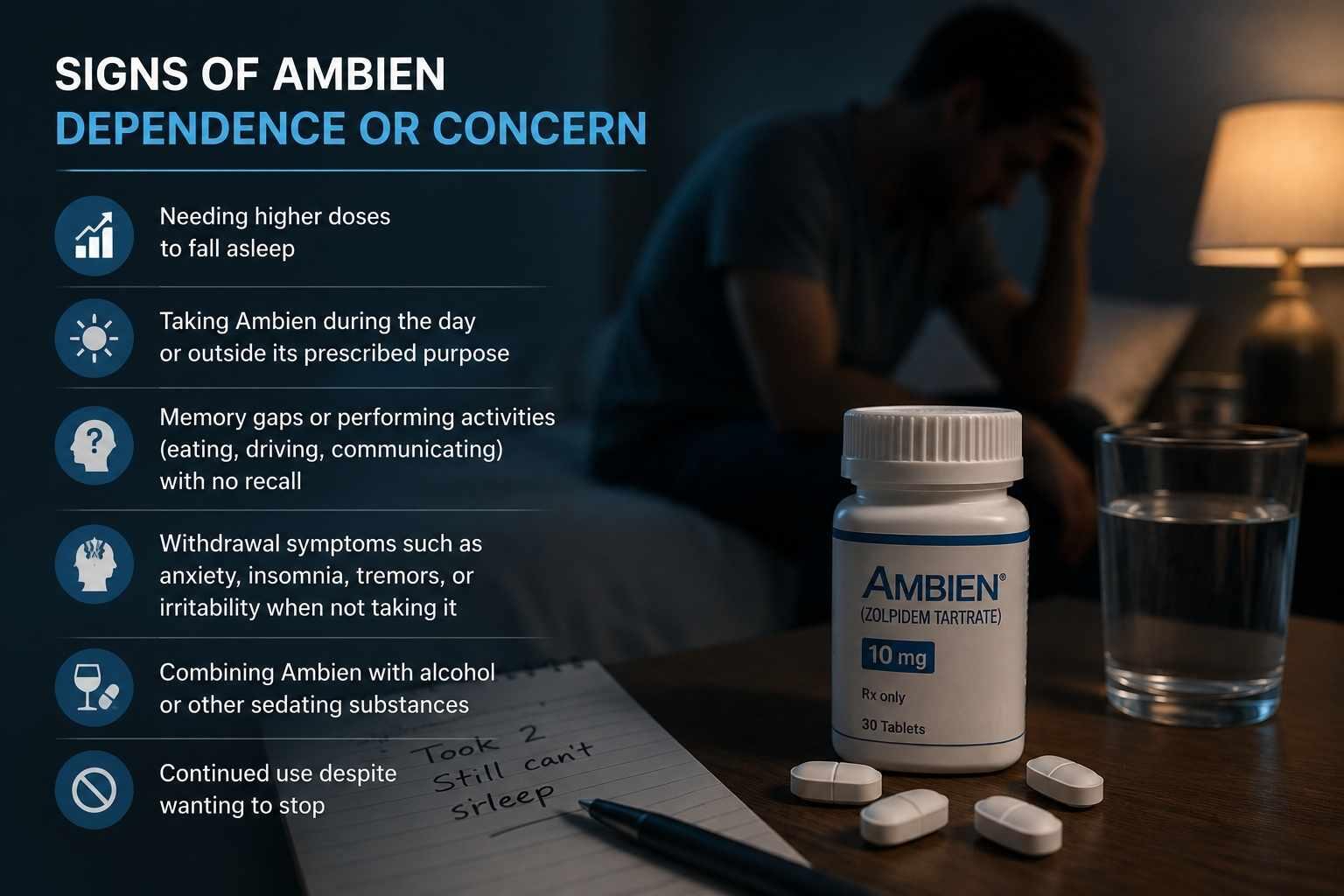
- Needing higher doses to fall asleep
- Taking Ambien during the day or outside its prescribed purpose
- Memory gaps or performing activities (eating, driving, communicating) with no recall
- Withdrawal symptoms such as anxiety, insomnia, tremors, or irritability when not taking it
- Combining Ambien with alcohol or other sedating substances
- Continued use despite wanting to stop
You can review a fuller list of sleep pill addiction signs on the Pacific View Detox site. If you recognize several of these patterns, speaking with a clinician is a reasonable next step.
Why Does Recovery Need to Continue Beyond Detox?
Detox focuses on safely managing withdrawal symptoms and stabilizing your physical condition. That’s essential. But it doesn’t address why you needed the medication in the first place, or what happens when the cravings return at 2 a.m.
Detox alone is generally not enough because it does not:
- Treat underlying anxiety, depression, or trauma that may have contributed to Ambien use
- Rebuild the ability to sleep without chemical assistance
- Address the behavioral patterns around taking a pill every night
- Prepare you for the stress, triggers, or situations that could lead to a return to use
- Provide the continued support that long-term addiction recovery requires
Rebound insomnia, a temporary but intense return of sleeplessness, is common after stopping Ambien. For many people, this is the most difficult part of early recovery. Without a plan to manage it, the urge to return to the medication becomes very strong.
| Detox | Full Ambien Rehab Treatment |
|---|---|
| Manage withdrawal safely | Addresses withdrawal and what causes it |
| Medical monitoring | Medical support plus behavioral care |
| No therapy included | Individual and group therapy |
| No sleep support | Sleep hygiene education and CBT-I |
| No mental health treatment | Co-occurring mental health assessment and care |
| No relapse prevention | Structured relapse prevention planning |
| No family component | Family involvement and education |
| Ends at stabilization | Includes continuing care planning |
Start Your Ambien Addiction Recovery Today
Overcome sleeping pill addiction for good. Pacific View Detox provides tailored rehab and relapse prevention plans. Start your addiction recovery today.
What Does Ambien Rehab Treatment Include After Detox?
A full recovery plan is built around your specific situation, your use history, dose, health, any co-occurring conditions, and what your life looks like outside of treatment.
A personalized plan may include:
- Individual therapy (such as cognitive behavioral therapy)
- Group therapy and peer support
- Sleep hygiene education and behavioral sleep strategies
- Mental health assessment and treatment for conditions like anxiety or depression
- Wellness techniques such as mindfulness, breathwork, or movement
- Relapse prevention planning
- Family education and involvement
- Continuing care coordination
Pacific View Detox takes an individualized approach to Ambien addiction treatment, addressing both the physical withdrawal and the emotional and behavioral aspects of dependence. No two plans look exactly the same.
Stages of an Ambien Recovery Plan
| Stage | Main Focus | What May Happen | Questions to Ask |
|---|---|---|---|
| Assessment | Understand full clinical picture | Medical history review, substance use evaluation, mental health screening | What conditions or factors affect my plan? |
| Medically supervised detox | Safe withdrawal management | Tapering, symptom monitoring, stabilization | How long will withdrawal last? What symptoms should I watch for? |
| Stabilization | Physical and emotional settling | Rest, nutritional support, initial therapy contact | Am I ready to begin deeper work? |
| Therapy and sleep support | Address behavioral and psychological roots | CBT, sleep hygiene education, group therapy | What therapy approach fits my history? |
| Relapse prevention planning | Build skills and prepare for real life | Trigger identification, coping strategies, support network building | What is my plan if I feel the urge to use? |
| Continuing care | Sustain progress | Outpatient support, peer groups, follow-up appointments | What does ongoing support look like for me? |
How Does Therapy Address Sleeping Pill Addiction?
Therapy is where much of the real work happens. Detox can get the medication out of your system. Therapy helps change the thought patterns and behaviors that keep you reaching for it.
Cognitive behavioral therapy (CBT) is one of the most evidence-supported approaches for sleeping pill addiction. It helps identify unhelpful beliefs about sleep (“I can’t function for less than eight hours” or “I will never sleep without Ambien”), and replaces them with more realistic, manageable thinking.
CBT adapted for insomnia, called CBT-I, directly addresses the behavioral and psychological drivers of poor sleep. It often produces better long-term results than medication alone. Pacific View Detox’s approach includes CBT and behavioral sleep strategies as part of its treatment model.
Consider this scenario: A patient uses Ambien primarily to manage stress at the end of long workdays. He doesn’t struggle with sleep in the traditional sense, he simply never developed another way to wind down. After detox, therapy helps him identify that pattern and build alternative routines, rather than assuming the medication was just for sleep.
How Can Healthy Sleep Be Rebuilt Without Ambien?
Rebuilding sleep is one of the most challenging parts of a full recovery plan for Ambien addiction. Rebound insomnia is real, and knowing it’s temporary can help, but having practical strategies matters more.
Evidence-based sleep support may include:
- Sleep restriction and stimulus control techniques (part of CBT-I)
- Consistent sleep and wake times, even on weekends
- Reducing caffeine, alcohol, and screen exposure before bed
- Temperature management and low-stimulation sleep environments
- Relaxation techniques such as progressive muscle relaxation or guided breathing
- Understanding that early sleep difficulties are a predictable part of recovery, not a sign that something has gone wrong
What Role Does Mental Health Treatment Play?
Ambien is often prescribed for insomnia that is itself driven by anxiety, depression, trauma, or stress. Treating the sleep problem without addressing what’s underneath it means the insomnia, and the pull toward medication, is likely to return.
A good treatment program includes a mental health assessment early in the process. If a co-occurring condition is present, addressing it is part of the addiction recovery plan, not separate from it.
Conditions that commonly co-occur with Ambien dependence include:
- Generalized anxiety disorder
- Major depression
- Post-traumatic stress disorder
- Chronic pain conditions
How Does Relapse Prevention Work After Ambien Detox?
Relapse prevention is not a single conversation, it is a structured part of treatment that prepares you to handle real-life situations without returning to use.
Practical relapse prevention strategies may include:
- Identifying personal triggers (stress at work, relationship conflict, bad nights of sleep)
- Building a concrete response plan for high-risk situations
- Practicing refusal skills and how to handle access to the medication
- Understanding that a difficult night of sleep is not a crisis
- Developing a support network that can be contacted when urges arise
- Planning what to do if a return to use occurs, without shame or delay in seeking help
Because Ambien-related sleeping pill addiction often involves using the medication to cope with stress or emotion rather than only for clinical insomnia, relapse prevention must account for those patterns specifically.
If you need to understand what a structured withdrawal management approach looks like, the Pacific View Detox page on benzo withdrawal treatment explains their medically supervised model, which shares similarities with Ambien detox protocols given that both drugs act on GABA receptors.
How Can Family Support Help With Addiction Recovery?
Family members are often the first to notice the signs, memory gaps, taking Ambien during the day, returning to use after trying to stop. And they’re often unsure what to do next.
Ways families can support recovery without enabling continued use:
- Ask questions calmly, without accusations or ultimatums
- Contact an admissions team for guidance before confronting the situation directly
- Avoid dispensing or monitoring medication yourself unless directed by a clinician
- Learn about rebound insomnia and why early recovery sleep can be difficult
- Participate in family education programs if the treatment center offers them
- Understand that encouragement and patience matter, recovery is rarely straightforward
Questions families should ask when researching treatment:
- Does the program address sleep problems specifically, not just withdrawal?
- Is family involvement part of the plan?
- What happens if my loved one returns to Ambien use after treatment?
- How does the team handle co-occurring mental health conditions?
- Can I speak with someone in admissions before my loved one is ready to call?
What Happens During Assessment and Admissions?
Understanding the admissions process helps reduce anxiety about reaching out.
The Pacific View Detox admissions process:
- Schedule a pre-assessment – Contact the team by phone or online at any time
- Speak with an admissions coordinator – A compassionate staff member reviews your situation, history, and goals in a judgment-free conversation
- Verify insurance and discuss financing – The team works with your insurance provider to confirm coverage; alternative options are discussed if needed
- Coordinate travel and arrival – If you’re coming from outside the immediate Dana Point area, the team can assist with logistics
- Complete medical and clinical evaluation – A thorough intake assessment covers medical history, current health, substance use, and mental health
- Receive a personalized treatment plan – Recommendations are based on your specific clinical needs, not a one-size model
Timelines depend on availability, insurance, and clinical need. The admissions team can answer those questions during your first call.
Questions to ask before beginning treatment:
- What level of care is recommended for my situation?
- Will my insurance cover this, and for how long?
- What does a typical day in treatment look like?
- How is sleep managed during and after detox?
- What support is available once I leave the program?
How Long Does Ambien Rehab Treatment Take?
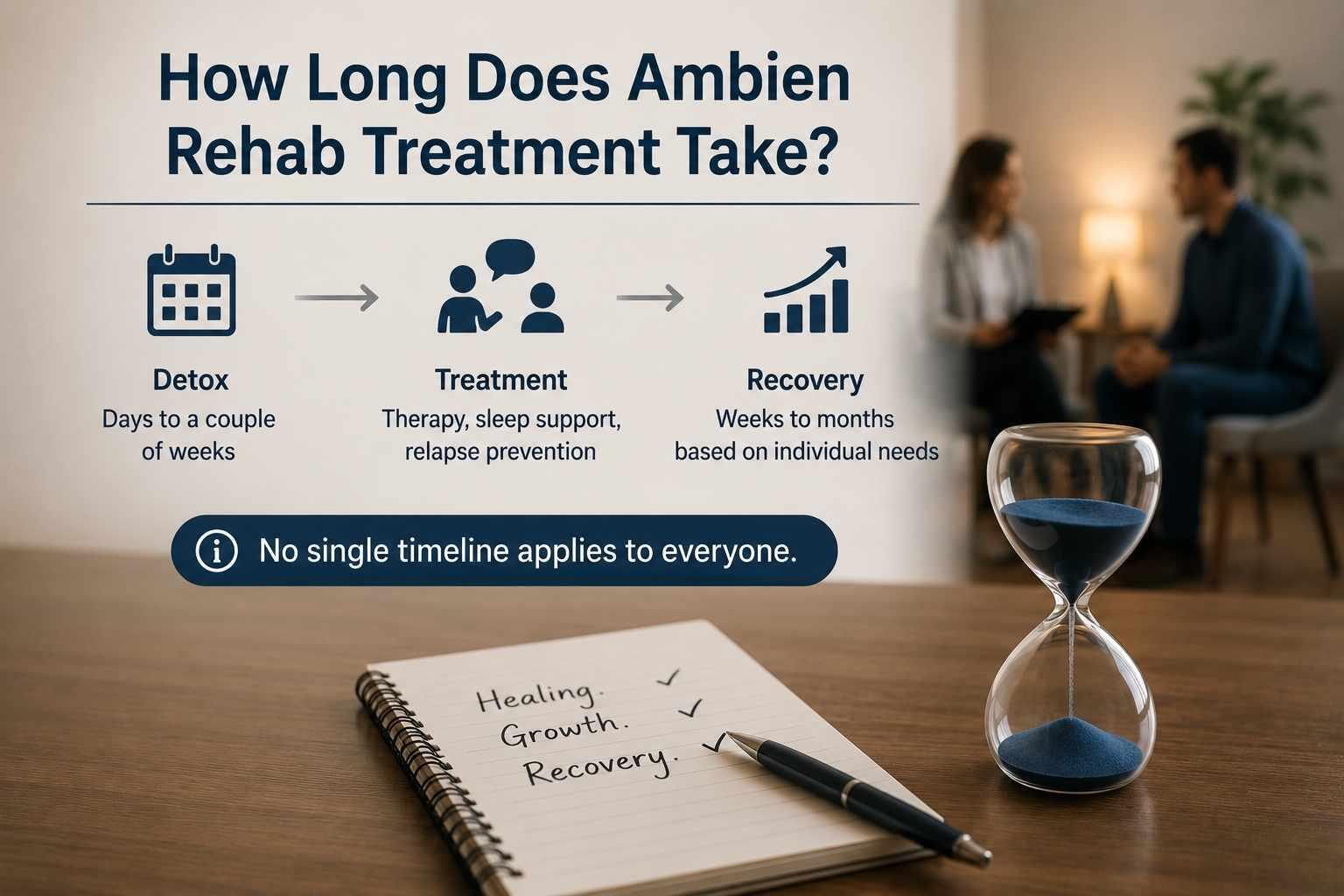
There is no single timeline that applies to everyone. How long this treatment takes depends on the length and dose of prior use, any co-occurring health conditions, the level of care recommended, and how individual recovery progresses.
Detox typically takes days to a couple of weeks. The broader treatment phase, therapy, sleep support, relapse prevention, may extend for weeks to months depending on clinical needs and what programs a person participates in. Recovery timelines should never be presented as guarantees.
What Does Treatment Cost and Does Insurance Cover It?
Treatment cost depends on clinical needs, length of care, recommended services, and insurance benefits.
Pacific View Detox works with major insurance providers, and coverage may be full, partial, or subject to specific plan requirements. The admissions team can verify your benefits confidentially before you make any decision about treatment.
If you are uninsured or out of network, discuss options directly with the admissions coordinator. Financial concerns should not prevent you from getting accurate information about what is possible.
Insurance and cost questions to ask:
- Does my plan cover medically supervised detox?
- Is residential or outpatient treatment covered differently?
- What are my out-of-pocket costs after insurance?
- Are there payment support options if my coverage is limited?
Review the treatments overview on the Pacific View Detox site for information on available services and approach.
Ambien Addiction Treatment Near Dana Point, California
Pacific View Detox is located in Dana Point, in Orange County, Southern California. The facility serves people from across the region, including those in Laguna Beach, Mission Viejo, San Clemente, and surrounding communities.
For many people, choosing treatment close to home means that family can participate more easily, that the transition back to daily life is smoother, and that local follow-up care is more accessible. For others, distance from familiar environments is part of the recovery plan.
If you’re searching for Ambien addiction treatment near me in Orange County or Southern California, the Pacific View Detox admissions team can help you evaluate whether the program is the right fit for your needs.
Frequently Asked Questions
{
“@context”: “https://schema.org”,
“@type”: “FAQPage”,
“mainEntity”: [
{
“@type”: “Question”,
“name”: “What is Ambien rehab treatment?”,
“acceptedAnswer”: {
“@type”: “Answer”,
“text”: “Ambien rehab treatment is a structured clinical program that addresses dependence on zolpidem (Ambien). The goal is to address both the physical and behavioral aspects of dependence.”
}
},
{
“@type”: “Question”,
“name”: “Is Ambien detox enough for recovery?”,
“acceptedAnswer”: {
“@type”: “Answer”,
“text”: “For most people, detox alone is not enough. It manages withdrawal safely but does not address the thought patterns, sleep habits, or triggers that contribute to dependence. A full recovery plan includes therapy and continued support after stabilization.”
}
},
{
“@type”: “Question”,
“name”: “How long does Ambien rehab treatment take?”,
“acceptedAnswer”: {
“@type”: “Answer”,
“text”: “Timelines vary based on use history, dose, health, and clinical needs. Detox may take days to two weeks. Broader treatment, including therapy and relapse prevention work, may continue for weeks to months. No timeline can be guaranteed.”
}
},
{
“@type”: “Question”,
“name”: “Can someone become dependent while taking Ambien as prescribed?”,
“acceptedAnswer”: {
“@type”: “Answer”,
“text”: “Yes. Physical dependence can develop even when Ambien is used exactly as directed. The brain adapts to the presence of the medication over time. This is why changes to any prescribed medication should be discussed with a qualified medical professional first.”
}
},
{
“@type”: “Question”,
“name”: “What happens if someone stops Ambien suddenly?”,
“acceptedAnswer”: {
“@type”: “Answer”,
“text”: “Stopping Ambien suddenly may cause withdrawal symptoms including severe insomnia, anxiety, tremors, irritability, and in some cases more serious complications. Stopping or tapering should always be discussed with and supervised by a qualified clinician. If someone is experiencing distressing symptoms, they should seek medical care promptly.”
}
},
{
“@type”: “Question”,
“name”: “How is sleep managed after Ambien detox?”,
“acceptedAnswer”: {
“@type”: “Answer”,
“text”: “Rebuilding sleep without Ambien takes time and specific strategies. Treatment may include CBT-I (cognitive behavioral therapy for insomnia), sleep hygiene education, and wellness techniques. Sleep often improves gradually over weeks. Any non-Ambien sleep support should be discussed with a prescribing professional.”
}
},
{
“@type”: “Question”,
“name”: “How does relapse prevention work?”,
“acceptedAnswer”: {
“@type”: “Answer”,
“text”: “Relapse prevention involves identifying personal triggers, building coping strategies, creating a support plan, and practicing how to respond when the urge to use arises. It is woven into the treatment process, not added on at the end.”
}
},
{
“@type”: “Question”,
“name”: “Does insurance cover Ambien addiction treatment?”,
“acceptedAnswer”: {
“@type”: “Answer”,
“text”: “Many insurance plans cover medically supervised detox and addiction treatment. Coverage depends on your specific plan and benefits. Pacific View Detox offers confidential insurance verification through the admissions process.”
}
},
{
“@type”: “Question”,
“name”: “Can family members contact admissions?”,
“acceptedAnswer”: {
“@type”: “Answer”,
“text”: “Yes. Family members can call 888-599-8382 at any time to ask questions, understand the process, or get guidance on supporting a loved one. You do not need to wait until the person is ready to call themselves.”
}
},
{
“@type”: “Question”,
“name”: “Is Ambien addiction treatment available near Dana Point?”,
“acceptedAnswer”: {
“@type”: “Answer”,
“text”: “Yes. Pacific View Detox is located in Dana Point, Orange County, and serves people from across Southern California, including Laguna Beach, Mission Viejo, and San Clemente. The admissions team can discuss whether the program is the right fit for your situation.”
}
}
]
}
What is Ambien rehab treatment?
Ambien rehab treatment is a structured clinical program that addresses dependence on zolpidem (Ambien). The goal is to address both the physical and behavioral aspects of dependence.
Is Ambien detox enough for recovery?
For most people, detox alone is not enough. It manages withdrawal safely but does not address the thought patterns, sleep habits, or triggers that contribute to dependence. A full recovery plan includes therapy and continued support after stabilization.
How long does Ambien rehab treatment take?
Timelines vary based on use history, dose, health, and clinical needs. Detox may take days to two weeks. Broader treatment, including therapy and relapse prevention work, may continue for weeks to months. No timeline can be guaranteed.
Can someone become dependent while taking Ambien as prescribed?
Yes. Physical dependence can develop even when Ambien is used exactly as directed. The brain adapts to the presence of the medication over time. This is why changes to any prescribed medication should be discussed with a qualified medical professional first.
What happens if someone stops Ambien suddenly?
Stopping Ambien suddenly may cause withdrawal symptoms including severe insomnia, anxiety, tremors, irritability, and in some cases more serious complications. Stopping or tapering should always be discussed with and supervised by a qualified clinician. If someone is experiencing distressing symptoms, they should seek medical care promptly.
How is sleep managed after Ambien detox?
Rebuilding sleep without Ambien takes time and specific strategies. Treatment may include CBT-I (cognitive behavioral therapy for insomnia), sleep hygiene education, and wellness techniques. Sleep often improves gradually over weeks. Any non-Ambien sleep support should be discussed with a prescribing professional.
How does relapse prevention work?
Relapse prevention involves identifying personal triggers, building coping strategies, creating a support plan, and practicing how to respond when the urge to use arises. It is woven into the treatment process, not added on at the end.
Does insurance cover Ambien addiction treatment?
Many insurance plans cover medically supervised detox and addiction treatment. Coverage depends on your specific plan and benefits. Pacific View Detox offers confidential insurance verification through the admissions process.
Can family members contact admissions?
Yes. Family members can call 888-599-8382 at any time to ask questions, understand the process, or get guidance on supporting a loved one. You do not need to wait until the person is ready to call themselves.
Is Ambien addiction treatment available near Dana Point?
Yes. Pacific View Detox is located in Dana Point, Orange County, and serves people from across Southern California, including Laguna Beach, Mission Viejo, and San Clemente. The admissions team can discuss whether the program is the right fit for your situation.
Medical Review Statement:
This article should be reviewed by a qualified medical professional before publication. It is for educational purposes only and should not replace medical advice, diagnosis, prescribed treatment, or emergency care. If someone is experiencing a medical emergency related to Ambien use or withdrawal, call 911 immediately.
Moving Forward After Ambien Detox
Ambien rehab treatment does not end when withdrawal is managed. For most people, that’s where the real work begins, understanding what drove the dependence, rebuilding the ability to sleep naturally, and developing the tools to handle stress and triggers without reaching for a pill.
Recovery timelines differ. Progress is not always linear. But having a clear, personalized plan after detox gives you something detox alone cannot: a realistic path forward.
If you or someone in your family is dealing with Ambien dependence and you’re not sure what to do next, Pacific View Detox’s admissions team is available 24/7 for a confidential conversation. They can help you understand your options, verify insurance, and make a plan that fits your circumstances.
Call 888-599-8382 or contact Pacific View Detox today.