Does Insurance Pay for Alcohol Rehab in California? What You Need to Know
The cost of rehab is the first thing most people worry about when they consider getting help. It stops a lot of people from even making the call. But here’s what many don’t realize: if you have health insurance, there is a strong chance that alcohol rehab in California is already covered, fully or substantially, under your plan.
The question is not really whether insurance covers rehab. Federal law requires it. The real question is how much your specific plan covers, what level of care qualifies, and how to find out without spending hours on hold with your insurer.
This post answers those questions directly. If you are in Dana Point, Orange County, or anywhere in Southern California and want to know where you stand, verify your insurance at Pacific View Detox or call 888-599-8382, the team will check your benefits confidentially, usually within the same call.
Key Takeaways
- Federal law requires most health insurance plans to cover addiction treatment at the same level as medical care
- California state law adds additional protections for residents seeking alcohol and drug rehab coverage
- Detox insurance coverage under 2026 guidelines applies to commercial plans, Medi-Cal, Covered California, and most employer-sponsored plans
- Rehabs in California that take insurance include facilities offering detox, residential, PHP, and IOP levels of care
- Out-of-pocket costs depend on your deductible, copay, and whether the facility is in-network
- Pacific View Detox accepts major insurance and works with families across Orange County, San Diego County, and Los Angeles County
What the Law Actually Says About Insurance and Rehab
Two federal laws directly govern this. The Mental Health Parity and Addiction Equity Act (MHPAEA) of 2008 requires that insurance plans offering mental health and substance use disorder benefits cannot place more restrictive limits on those benefits than they do on medical or surgical care. The Affordable Care Act reinforced this by classifying substance use disorder treatment as one of ten essential health benefits that marketplace plans must cover.
California adds its own layer. Senate Bill 855, signed into law in 2020, requires California insurers to cover all medically necessary treatment for mental health and substance use disorders, including residential rehab, detox, and outpatient levels of care. This applies to fully insured commercial plans regulated by the state.
In practical terms: if you have a California health insurance plan, the insurer cannot deny medically necessary alcohol rehab. They can, however, apply prior authorization requirements, limit network options, and set cost-sharing rules that affect what you pay. Understanding those details is where the work happens.
What Does Insurance Cover in Alcohol Rehab?
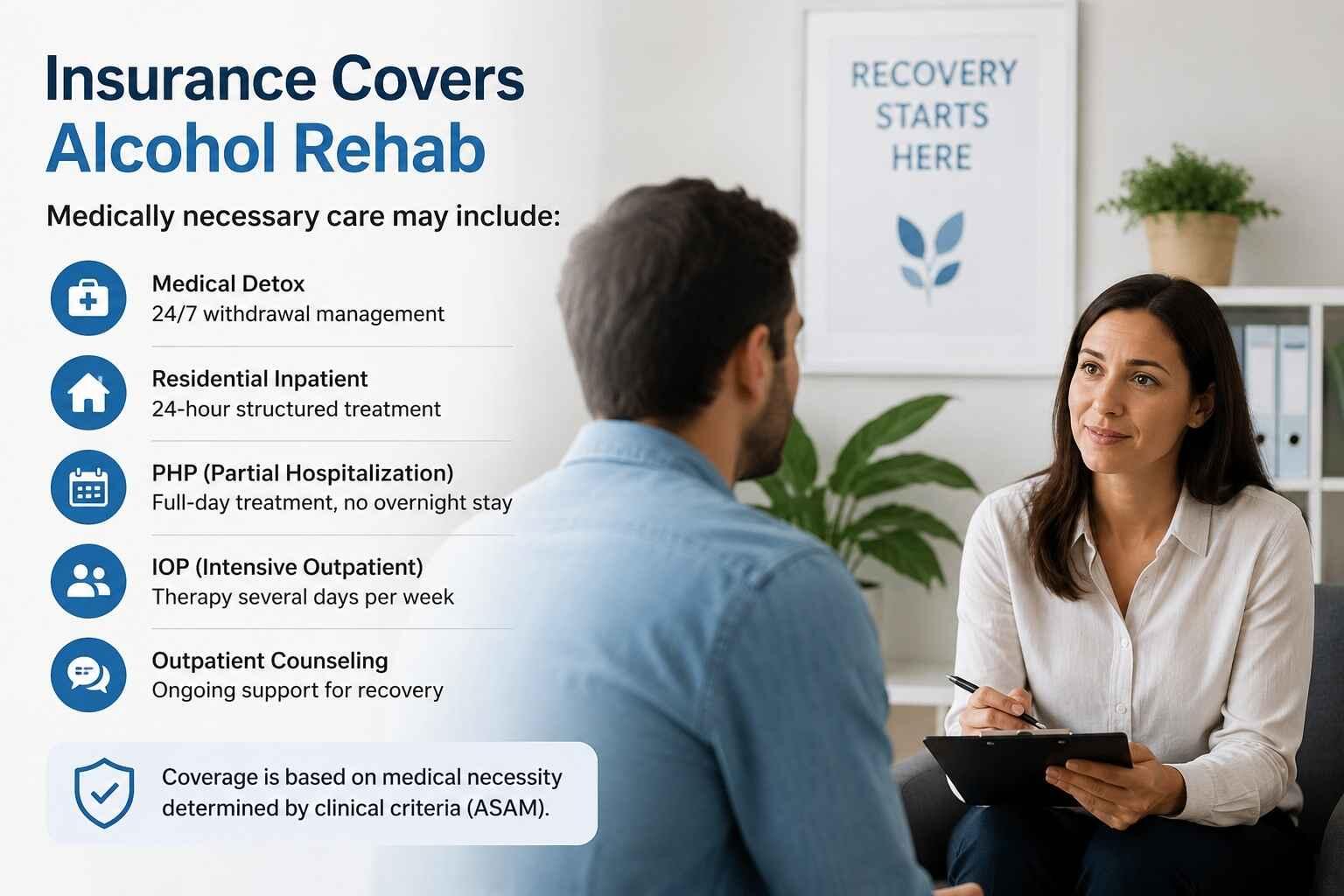
Most plans cover the following levels of care when they are medically necessary:
- Medical detox, 24/7 monitored withdrawal management, IV fluids, medications for seizure prevention and withdrawal symptoms
- Residential inpatient treatment, structured 24-hour programming including therapy, psychiatric support, and medical monitoring
- Partial Hospitalization Program (PHP), full-day clinical programming (typically 5 to 6 hours per day) without overnight stay
- Intensive Outpatient Program (IOP), structured therapy several days per week, typically used as a step-down from PHP or residential
- Outpatient counseling, ongoing individual or group therapy to support sustained recovery
Coverage is not automatic for all levels. Insurers use clinical criteria, usually the ASAM (American Society of Addiction Medicine) placement criteria, to determine which level of care is medically necessary for a given individual. A person with severe physical dependence typically qualifies for medical detox and residential care. Someone with mild dependence and stable housing may qualify for IOP.
Verify Your Insurance for Alcohol Rehab in California Today
Find out what your insurance covers for alcohol rehab in California. Our admissions team verifies benefits confidentially with no obligation.
Detox Insurance Coverage in 2026: What Has Changed
The 2026 guidelines on detox insurance coverage reflect continued enforcement of federal parity law, with increased scrutiny on prior authorization practices. Key updates relevant to California residents include:
| Coverage Area | 2026 Status |
|---|---|
| Medical Detox | Covered as medically necessary under most commercial and Medi-Cal plans. |
| Residential Treatment | Covered with prior authorization; length of stay determined by clinical review. |
| PHP and IOP | Broadly covered; most plans require step-down documentation. |
| Medi-Cal (Medicaid) | Covers the full SUD treatment continuum through the Drug Medi-Cal Organized Delivery System (DMC-ODS). |
| Covered California Plans | Must cover all ten essential health benefits, including substance use disorder (SUD) treatment. |
| Short-Term Health Plans | May not cover SUD treatment; verify your plan before assuming coverage. |
One shift worth noting: insurers are under increased regulatory pressure in 2026 to reduce prior authorization delays for SUD treatment specifically. California’s AB 2102 and related legislation continue tightening timelines for insurer responses to treatment authorization requests.
Types of Rehab Insurance Covers in California
Not all rehab programs operate the same way, and insurance coverage varies by program type. Here is a direct breakdown:
| Program Type | Typical Insurance Coverage | Notes |
|---|---|---|
| Medical Detox | Usually covered in full or near full. | Most critical first step; rarely denied when documented as medically necessary. |
| Residential Inpatient | Covered with prior authorization. | Length of stay is subject to ongoing clinical review. |
| PHP | Widely covered. | Good option when residential treatment is not authorized. |
| IOP | Covered under most plans. | Often used as a step-down or primary treatment option. |
| Standard Outpatient | Covered under most plans. | Lowest intensity; typically no prior authorization is required. |
At alcohol and drug rehab centers in California like Pacific View Detox, the admissions team handles the insurance verification process and communicates directly with your insurer to confirm what is covered before treatment begins. You do not need to navigate this alone.
Rehabs in California That Take Insurance: What to Look For
Not every facility is set up to work with insurance effectively. When evaluating rehabs in California that take insurance, look for these indicators:
- In-network status with your plan, in-network facilities have pre-negotiated rates that significantly reduce out-of-pocket costs
- DHCS licensure, California’s Department of Health Care Services licenses addiction treatment facilities; always confirm active licensure
- On-site insurance verification, reputable facilities verify benefits before admission, not after
- Clear disclosure of costs, you should know your estimated out-of-pocket responsibility before signing anything
- Willingness to handle prior authorization, this is a time-sensitive process; experienced admissions teams manage it so treatment is not delayed
Pacific View Detox holds active DHCS licensure (License #300722AP) and works with Cigna, Aetna, BlueCross BlueShield, Anthem, United Healthcare, Humana, and others. The admissions team at our Dana Point facility handles insurance verification and prior authorization as part of standard intake, not as a separate process.
What You May Still Owe Out of Pocket
Even with insurance, most people have some cost-sharing responsibility. The main factors that affect what you pay:
Deductible: The amount you pay before insurance begins covering costs. If your deductible is not yet met for the year, you may pay more at the start of treatment.
Copay or coinsurance: Your share of costs after the deductible is met, typically a fixed dollar amount (copay) or a percentage of the total cost (coinsurance).
Out-of-pocket maximum: Once your total spending hits this limit in a plan year, insurance covers 100% of covered services for the rest of the year. Rehab often counts toward this.
In-network vs. out-of-network: Using an out-of-network facility typically means higher out-of-pocket costs. If you have a PPO, you may still have partial coverage for out-of-network care. HMO plans generally do not cover out-of-network care except in emergencies.
A realistic conversation about costs requires knowing your specific plan details. The fastest way to get that clarity is a direct insurance verification call, which Pacific View Detox provides at no cost or obligation.
How to Verify Your Coverage Before You Commit

You have two options: call your insurer directly, or let the facility verify it for you.
Calling your insurer works, but it requires knowing exactly what to ask. Many people get incomplete answers because they ask general questions rather than specific ones, such as whether a particular facility is in-network, what prior authorization is required, and what the out-of-pocket maximum for SUD treatment is.
Letting an experienced admissions team verify your benefits is faster and typically more accurate. They know what questions to ask, how to document medical necessity, and how to initiate prior authorization correctly.
Start your insurance verification at Pacific View Detox online, or call 888-599-8382, the process takes about ten minutes and there is no commitment involved.
For Families: Getting Someone Else Into Treatment
Family members in Orange County, Los Angeles County, and San Diego County contact Pacific View Detox regularly to ask how to help someone who is not yet ready to ask for help themselves.
The insurance question often comes up here too: can a family member verify insurance for a loved one? In most cases, the policyholder, which may be a parent or spouse, can verify benefits and begin the admissions process on behalf of the person seeking treatment, particularly when the person is in active crisis.
If your loved one is struggling with alcohol dependence and you want to understand their coverage and options before approaching them, our admissions team can walk through that with you confidentially. Call 888-599-8382 at any time.
Medical Review Statement: This article has been prepared with reference to federal and California state insurance law and clinical treatment standards. It is intended for informational purposes only and does not constitute legal, financial, or medical advice. Insurance coverage terms vary by plan. Contact your insurer or our admissions team directly for accurate information about your specific benefits. If you or someone you love is in a medical crisis related to alcohol use, call 911 or seek emergency care immediately.
FAQ
Does insurance cover rehab for alcohol use disorder in California?
Yes. Federal law under the Mental Health Parity and Addiction Equity Act requires that insurance plans covering mental health and substance use disorder treatment do so at the same level as medical care. California’s SB 855 adds further state-level protections requiring coverage of all medically necessary SUD treatment, including detox and residential care.
Which insurance plans cover alcohol rehab in California?
Most commercial plans, Covered California marketplace plans, Medi-Cal, and employer-sponsored plans cover alcohol rehab when it is medically necessary. Short-term health plans and some limited benefit plans may not. Verifying your specific plan benefits before admission is always the right first step.
How do I find rehabs in California that take my insurance?
Call the facility’s admissions team and provide your insurance card information. A reputable facility will verify your benefits, confirm in-network status, and explain your estimated cost-sharing responsibility before you commit to anything. Pacific View Detox in Dana Point does this as part of standard intake.
What is the detox insurance coverage process in 2026?
Most insurers require prior authorization for medical detox and residential treatment. The facility’s admissions team initiates this by submitting documentation of medical necessity based on clinical assessment. Turnaround time for authorization decisions has been tightened under 2026 regulatory guidelines; most commercial plans must respond within 24 to 72 hours for urgent SUD cases.
Does Medi-Cal cover alcohol detox and rehab in California?
Yes. Medi-Cal covers a full SUD treatment continuum through the Drug Medi-Cal Organized Delivery System (DMC-ODS), including outpatient services, residential treatment, and withdrawal management (detox). Eligibility and covered services vary by county.
What does alcohol rehab in California typically cost without insurance?
Costs vary significantly by program type and facility. Medical detox programs in California range from approximately $1,500 to $3,000 per day without insurance. Residential treatment can range from $500 to $1,500 per day. Most people with insurance pay a fraction of these costs, which is why verifying your benefits before assuming you cannot afford treatment is important.
Is Pacific View Detox in-network with major insurance plans?
Pacific View Detox works with Cigna, Aetna, BlueCross BlueShield, Anthem, United Healthcare, Humana, and other major carriers. In-network status depends on your specific plan. Call 888-599-8382 or use the online verification form to confirm your benefits with no obligation.
How long does insurance typically cover residential alcohol rehab?
Insurance does not approve a fixed number of days upfront. Coverage is determined through ongoing clinical review using the ASAM criteria. Most insurers initially authorize short stays and extend authorization based on clinical progress. Having an experienced clinical team document your progress accurately is key to maximizing coverage.
Can a family member start the insurance verification process for a loved one?
In most cases, yes, particularly if the family member is the policyholder. Contact Pacific View Detox at 888-599-8382 to discuss your specific situation. Our admissions team works with families regularly and can help you understand options and coverage before the person in need is ready to make the call themselves.
Where is Pacific View Detox located and what areas does it serve?
Pacific View Detox is located at 34405 Via Gomez, Dana Point, CA 92624, in Southern California’s Orange County. The facility serves clients from Dana Point, San Clemente, Laguna Beach, Mission Viejo, Los Angeles County, San Diego County, and across California.
Start with One Call
Cost should not be the reason someone does not get help for alcohol dependence. For most people with health insurance in California, alcohol rehab is a covered benefit, and the admissions team at Pacific View Detox can confirm exactly what your plan covers in about ten minutes.
Verify your insurance online or call 888-599-8382 now. The call is confidential, there is no obligation, and it answers the one question most people need answered before they can take the next step. Contact us directly with any questions about our Dana Point facility, our alcohol treatment program, or what to expect during admissions.