Medications for Alcohol Use Disorder: Can a Pill Quiet Your Cravings?
Objective
Explain how medications for alcohol use disorder actually work, how naltrexone, acamprosate, and disulfiram differ, and where medication fits into a real treatment plan at Pacific View Detox in Dana Point, California.
Key Takeaways
- Medications for alcohol use disorder don’t eliminate cravings entirely, but they reduce their intensity enough to make recovery manageable
- Naltrexone blocks the reward response from drinking, while acamprosate targets the brain chemistry imbalance that drives cravings after someone stops
- Disulfiram works through deterrence, making drinking physically unpleasant rather than blocking the urge itself
- Untreated cravings are one of the most common reasons people relapse in the first 90 days after quitting
- Medication alone rarely produces lasting recovery. It works best paired with therapy, structured support, and family involvement
- Pacific View Detox integrates medication-assisted treatment into a broader, individualized recovery plan serving Orange County and Southern California
A client once described it to our team like this: he could go three or four days without a drink through sheer willpower. Then something would trigger it, a bad day, a familiar bar, a friend’s text, and the craving would hit so hard that willpower stopped mattering. He didn’t need more discipline. He needed the craving itself to be quieter.
That’s the actual problem medication solves. Not the desire to drink in some abstract sense, but the specific, physical intensity of a craving once it starts. For a lot of people, that intensity is the difference between staying sober and relapsing on day four.
Medications for alcohol use disorder exist for exactly this reason, and our admissions team fields questions about them from patients and family members almost daily. This guide breaks down how they work, how the three main options differ, and where they actually fit into a treatment plan.
If a loved one is the one struggling and you’re reading this on their behalf, that’s common too. Families usually make this first call, not the person drinking. Reach our team at 888-599-8382 for a confidential conversation, whichever side of this you’re on.
What Are Medications for Alcohol Use Disorder, and How Do They Work?
Medications for alcohol use disorder target the brain chemistry that drives cravings and reward, not the behavior of drinking itself. Three FDA-approved options exist, and each works through a different mechanism.
Naltrexone blocks the reward. Acamprosate calms the chemical imbalance left behind after someone stops drinking. Disulfiram makes drinking physically unpleasant, discouraging the behavior through consequence rather than craving reduction. None of them are interchangeable, and picking the wrong one for someone’s situation limits how much they actually help.
A prescriber usually chooses based on a person’s drinking pattern, whether full abstinence or reduced drinking is the goal, and any other health conditions in play. That’s a clinical decision, made during intake, not a one-size-fits-all prescription handed out on day one.
How Does Naltrexone for Alcoholism Actually Work?
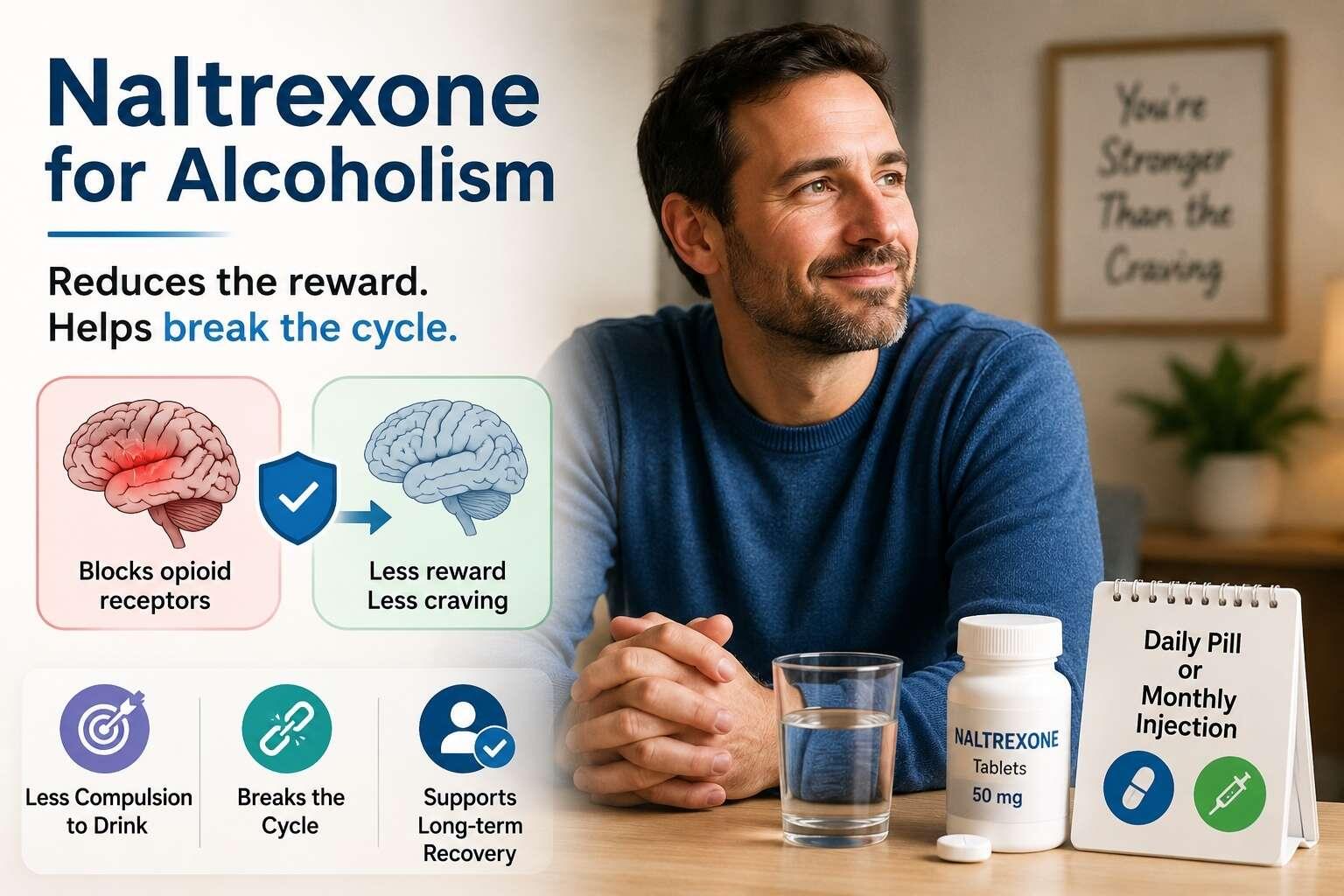
Naltrexone blocks opioid receptors in the brain, which dulls the pleasurable reward alcohol normally triggers. Less reward tends to mean less compulsion to keep drinking once someone starts.
Who Naltrexone Tends to Help Most
This matters most for people who struggle with the “one drink turns into ten” pattern. Naltrexone doesn’t stop someone from picking up the first drink. It reduces the payoff once they do, which for a lot of clients breaks the momentum that used to carry a single drink into a full relapse.
It’s available as a daily pill or a monthly injection, which helps with the adherence problem that undermines a lot of oral medications. Someone who forgets to take a pill three days a week gets a fundamentally different result than someone on a monthly shot.
Acamprosate vs Naltrexone: What’s the Real Difference?
Acamprosate targets the brain’s glutamate and GABA systems, which become imbalanced after long-term drinking, rather than blocking the reward response the way naltrexone does. The two medications work on entirely separate mechanisms.
When Each One Gets Prescribed
Naltrexone is often the better fit for someone still drinking who wants to reduce intake or prevent a lapse from becoming a full relapse. Acamprosate is typically prescribed after someone has already stopped, aimed at reducing the post-acute withdrawal symptoms, anxiety, insomnia, restlessness, that can drag on for weeks and quietly push someone back toward alcohol.
| Factor | Naltrexone | Acamprosate |
|---|---|---|
| Mechanism | Blocks reward response | Corrects brain chemistry imbalance |
| Best used when | Still drinking or at relapse risk | After abstinence has started |
| Dosing | Daily pill or monthly injection | Multiple times daily |
| Liver considerations | Not recommended with liver disease | Safer for liver-impaired patients |
Some clients end up on one, some on neither, and a smaller number end up on both under close medical supervision. That decision belongs with a prescriber who knows the full picture, not a general assumption based on one medication being more popular than the other.
How Does Disulfiram for Alcohol Use Disorder Work Differently?
Disulfiram doesn’t touch cravings at all. It works by making the body react badly to alcohol, causing nausea, flushing, and a rapid heartbeat within minutes of drinking, which turns the decision to drink into an immediate deterrent.
This approach fits a specific kind of person: someone highly motivated to stay sober who wants a hard external stop between themselves and a drink, especially around situational risk, a wedding, a work event, a visit home. It’s less useful for someone still ambivalent about quitting, since disulfiram only works if the person actually takes it as prescribed every day.
It also requires real commitment to strict alcohol avoidance, including less obvious sources like cooking wine or certain mouthwashes. That’s a tradeoff worth discussing honestly with a prescriber before starting, not something to find out the hard way mid-treatment.
How Does a Doctor Decide Which Alcoholism Medication Fits You?
A prescriber walks through drinking history, health conditions, and personal goals before recommending any alcoholism medication, following roughly the same sequence for most patients.
- Review drinking pattern. Daily drinking, binge episodes, and years of use all point toward different medications
- Check liver and kidney function. This alone rules certain medications in or out immediately
- Clarify the goal. Reducing intake and full abstinence call for different first-line choices
- Screen for co-occurring conditions. Anxiety, depression, or other substance use change what’s safe to prescribe alongside alcohol medication
- Start with close follow-up. Most prescribers reassess within the first two to four weeks and adjust based on how someone’s actually responding
This isn’t a one-time decision. Medication that works during the hardest early weeks sometimes needs adjusting once someone’s stabilized, and that reassessment matters as much as the initial choice.
Are Prescription Pills for Drinking Enough on Their Own?
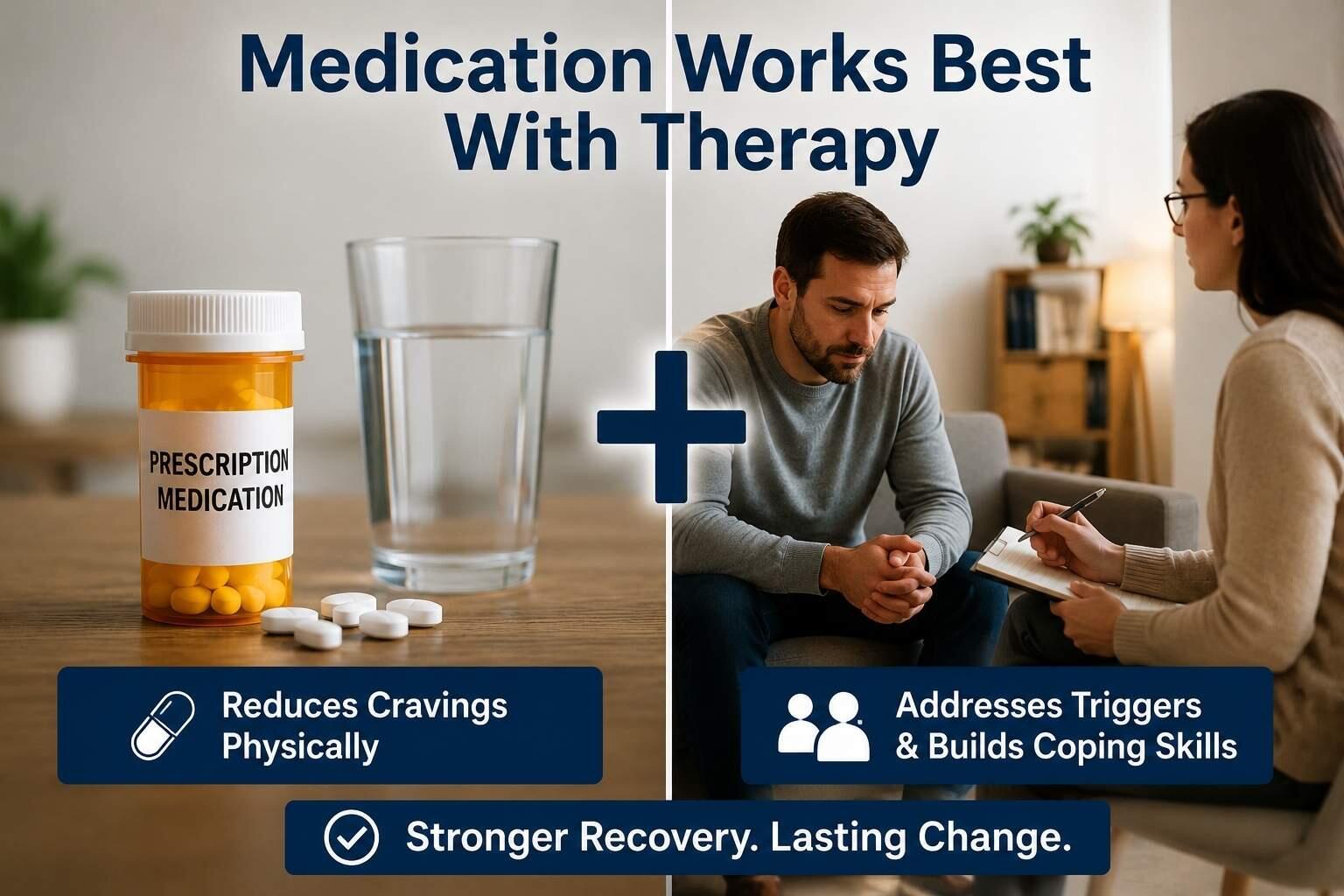
No. Prescription pills for drinking reduce the physical intensity of cravings, but they don’t address the behavioral patterns, triggers, or underlying stress that led to the drinking in the first place.
Medication without therapy tends to produce a specific failure pattern: cravings feel manageable for a while, so someone assumes they’ve “got it handled,” stops taking the medication, and the original triggers are still sitting there untouched. The medication bought time. It didn’t do the work that time was supposed to be used for.
That’s why medication-assisted treatment gets paired with structured therapy in any serious treatment program. Our related piece on effects of alcohol abuse therapy approaches breaks down what that pairing looks like in practice.
What Happens If Cravings Go Untreated?
Untreated cravings are one of the most common reasons people relapse in the first 90 days after quitting drinking, often catching families off guard after someone’s already made real progress.
A craving that isn’t managed doesn’t just fade with willpower over time. It tends to build, especially around known triggers, until a moment arrives where resistance runs out. That’s the exact moment naltrexone or acamprosate is designed to blunt, not by removing the trigger, but by lowering how hard it hits when it shows up.
Families sometimes read a relapse after weeks of sobriety as a character failure. Clinically, it’s usually a sign the craving side of treatment wasn’t addressed strongly enough, not proof that someone wasn’t trying.
What Does Alcoholism Medication Cost, and Is It Covered by Insurance?
Most major insurance plans cover FDA-approved alcoholism medication, especially when it’s part of a structured treatment program rather than a standalone prescription from an outside provider.
| Coverage Question | What to Expect |
|---|---|
| Is medication covered under insurance? | Usually, yes, particularly within a treatment program. |
| How is coverage confirmed? | Our team completes insurance verification confidentially before treatment starts. |
| Is the monthly naltrexone injection covered differently than the pill? | Coverage varies by plan. We confirm specifics during intake. |
| What if I don’t have insurance? | Call 888-599-8382 and we’ll walk through available options. |
How Does Medication Fit Into Treatment at Pacific View Detox in California?
Pacific View Detox integrates medication-assisted treatment into a full recovery plan built around each client’s specific drinking history and health needs, not a generic prescription handed out at intake.
Our clinical team evaluates whether naltrexone, acamprosate, or disulfiram makes sense as part of a broader plan that includes cognitive behavioral therapy, group support, and aftercare planning. Located in Dana Point, we serve clients from across Orange County, San Clemente, Laguna Beach, and greater Southern California, along with people specifically searching for alcohol addiction treatment near them who want quality care without leaving the state.
Medication gets reassessed throughout treatment, not set once and forgotten. Family involvement is welcomed throughout this process too. A lot of relapse-prevention planning works better when a spouse or parent understands what the medication is actually doing and what warning signs to watch for at home.
FAQ
How long do I need to take medication for alcohol use disorder?
It varies by person and medication. Some clients use naltrexone or acamprosate for six months to a year, others longer. Our clinical team reassesses regularly rather than setting a fixed end date upfront.
Can I start medication without going through detox first?
Acamprosate and disulfiram typically require some period of abstinence first. Naltrexone can sometimes start earlier. Your specific situation determines the right sequence, which we assess during intake.
Will medication make me stop wanting to drink completely?
No. It reduces the intensity of cravings and, in disulfiram’s case, creates a physical deterrent. None of these medications eliminate the desire to drink entirely, which is part of why therapy matters alongside them.
Is naltrexone or acamprosate better if I have liver problems?
Acamprosate is generally considered safer for people with liver impairment, since naltrexone carries specific liver-related precautions. This is exactly the kind of decision your prescriber needs your full medical history for.
Does insurance actually cover this, or will I be paying out of pocket?
Most major insurance plans cover these medications, especially as part of a treatment program. Call 888-599-8382 and we’ll verify your specific benefits before anything moves forward.
Is Pacific View Detox close to me if I live in Orange County?
We’re located in Dana Point and serve clients throughout Orange County, including San Clemente and Laguna Beach, along with people traveling in from across Southern California.
What if my spouse won’t admit their drinking is a problem?
Call us anyway. Our admissions team can walk you through how to approach the conversation, even before your spouse is ready to engage directly.
How soon after starting medication will cravings actually feel different?
Some clients notice a shift within the first one to two weeks, though it varies by medication and individual response. Your prescriber tracks this closely during early follow-up visits.
Do these medications interact with other prescriptions I’m already taking?
Possibly, depending on the medication. That’s part of why a full medical history review happens before anything gets prescribed, not after.
What happens during the first appointment if I want to explore medication?
A clinician reviews your drinking history, current health, and goals, then discusses which medication, if any, fits your situation. Insurance verification typically happens around the same time.
Take the First Step
A pill isn’t a finish line, but for a lot of people, it’s what makes the rest of recovery actually possible. Quieting the craving enough to get through the hardest weeks changes what someone can do with the therapy and support around them, and it changes what a family watching from the sidelines can actually help with.
Pacific View Detox builds medication-assisted treatment into a full, individualized recovery plan for clients across Dana Point, Orange County, and Southern California, backed by a clinical team that reassesses as you progress.
Call 888-599-8382 or contact us to talk through your options today.