Does Adderall Worsen Anxiety? Why Some People Feel Like Passing Out
To explain, in simple words, whether Adderall can worsen anxiety in real cases, what treatment centers notice in misuse and dependency commonly, and how to spot unhealthy reliance early. This article also explains the “crash,” panic spikes, and sleep disruption, and gently points toward professional help when anxiety starts running your life.
Clear Answer First: Does Adderall Worsen Anxiety in Real Cases?
Yes. Adderall can worsen anxiety in real cases, and treatment centers see it often.
Here is the key point. Adderall is a stimulant. It speeds up the nervous system. If your body already feels on edge, speeding it up more can push you into stronger anxiety.
That does not mean it always happens. Some people with ADHD feel calmer on the right dose because their brains can focus better. But many people feel more jittery, more tense, and more “wired,” especially if they do not have ADHD, take too much, take it too late, or use it to fight stress and exhaustion.
In treatment settings, a common story is this:
- “It helped at first.”
- “Then my anxiety got worse.”
- “Then I needed it to feel normal.”
That is the pattern this blog explains.
1) What Adderall Does to Your Body and Brain
Adderall is a stimulant medicine. It raises certain brain chemicals that affect attention and energy. Many people know it as an ADHD medication.
When it is working, people may feel:
- more alert
- more awake
- more focused
- more motivated
But it also affects the body. It can:
- raise heart rate
- raise blood pressure
- reduce appetite
- make it harder to sleep
- make muscles feel tense
That matters because anxiety is not only “in your head.” Anxiety is also in your body. When your body feels like it is in a stress mode, your brain can start to worry more.
2) Why Adderall Can Make Anxiety Worse
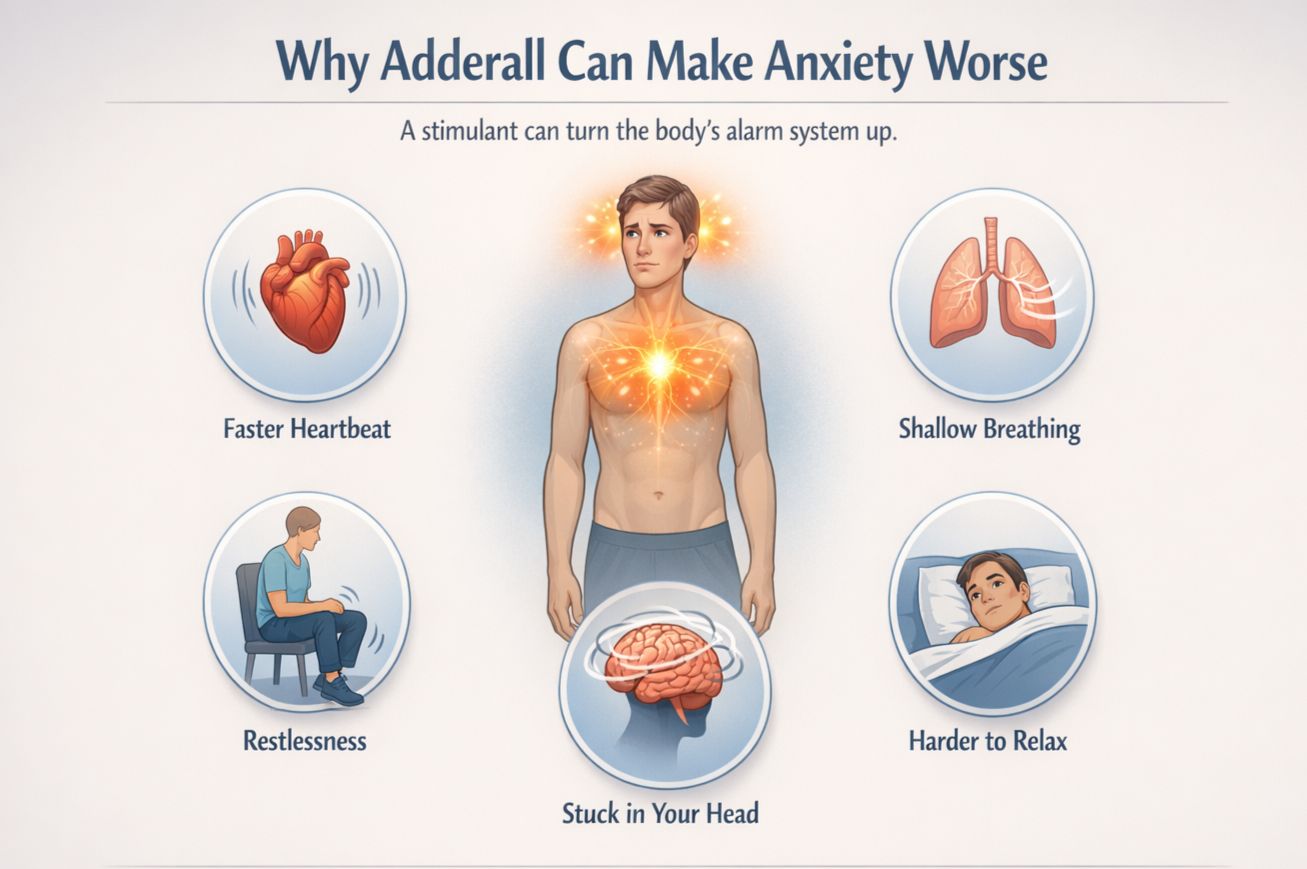
Anxiety often feels like a false alarm. Your body reacts as if something is wrong, even when nothing dangerous is happening.
A stimulant can turn that alarm up.
Adderall can make anxiety worse when it:
- makes your heart beat faster
- makes your breathing feel shallow
- makes you feel restless
- makes you feel “stuck” in your head
- makes it harder to relax
For some people, that feels like panic. For others, it feels like constant tension.
A very common experience
People say things like:
- “My chest feels tight.”
- “I can’t stop thinking.”
- “I feel shaky.”
- “I feel like something bad is about to happen.”
Those feelings can happen even if you are sitting still. That is why it can feel confusing. You may think, “Why am I anxious? Nothing is happening.” But your body is running faster than your life situation.
3) What Treatment Centers Often See in Misuse and Dependency
Treatment centers see patterns, not just symptoms. People arrive with different stories, but the patterns repeat.
Pattern A: Using Adderall to push through stress
Some people start using it to keep up with work, school, long shifts, or deadlines. It may be a helpful tool at first. Then the body starts to expect it.
Pattern B: Dose creep
This is when a person slowly takes more than they used to. Not always in a dramatic way. Sometimes it is small changes like:
- “I’ll take a little extra today.”
- “I’ll take it later in the day, too.”
- “I’ll take it on weekends now.”
Over time, the baseline shifts.
Pattern C: Using it to fix mood or energy
Instead of using it for a medical reason, some people start using it to avoid:
- fatigue
- low mood
- stress
- lack of motivation
This is where dependency can grow faster. Because the medication becomes the way to feel “okay.”
Clinicians at Pacific View Detox often talk about how dependency can sneak in quietly. Many people do not see it as “misuse” at first. They see it as “getting through the day.”
4) The Emotional Crash: Why It Feels So Bad
One of the biggest issues treatment centers hear about is the crash.
A crash is what some people feel when the medication wears off. The body goes from “up” to “down.” That drop can feel harsh.
During a crash, people may feel:
- sudden irritability
- sadness
- heavy tiredness
- brain fog
- low motivation
- strong worry
- a sense of dread
This is where anxiety can hit hard. Some people describe it as feeling “emotionally raw.”
Why does this lead to a risky cycle?
If the crash feels awful, a person may take another dose to avoid it. That may work for a short time. But it often makes the overall pattern worse:
- later crash
- worse sleep
- higher tension
- more anxiety
- stronger need to take it again
This is one of the most common cycles treatment centers see.
5) Panic Spikes and “Out of Nowhere” Fear
Panic spikes can happen in a few ways:
- During the peak: The stimulant effect is strong, and the body feels too activated.
- During the crash, the brain drops quickly, and anxiety surges.
- After poor sleep, the nervous system is already sensitive.
People often say panic feels like:
- fast heartbeat
- sweating
- shaking
- feeling trapped
- fear that something is wrong
- feeling like you might faint
Even when nothing is happening, your body is reacting as if it is in danger.
If this is happening often, it is not something to “power through.” It is a sign that the nervous system is overloaded.
6) Can Anxiety Cause You to Pass Out?
Some people experiencing anxiety or stimulant-related panic feel like they might faint. While actual fainting is less common, the sensation can feel very real.
Anxiety affects your nervous system, which can lead to:
- dizziness
- lightheadedness
- blurred vision
- a feeling of losing control
These symptoms can make it feel like you’re about to pass out, even if you don’t.
In some cases, especially during intense panic or hyperventilation, a person may briefly faint, but most people experience the fear of fainting, not actual loss of consciousness.
If you want a deeper explanation, read our full guide on can anxiety cause you to pass out.
7) Sleep Disruption: The Fastest Way Anxiety Gets Worse
Sleep is the part that many people underestimate. Treatment staff do not underestimate it because they see what happens when sleep is broken for weeks or months.
Adderall can affect sleep by:
- making it hard to fall asleep
- making sleep lighter
- causing early waking
- reducing deep rest
When sleep drops, anxiety rises. That is not a personality issue. It is biology.
Poor sleep can cause:
- more irritability
- more fear
- worse focus
- more negative thoughts
- stronger body tension
A person may then take more stimulants to function the next day. That makes sleep worse again. And the loop continues.
8) How to Self-Identify Unhealthy Reliance or Dosage Misuse
This part is about honesty, not shame. Many people do not mean to build reliance. It happens slowly.
Here are signs that often show up before a person fully realizes it:
Signs of unhealthy reliance
- You feel you cannot start your day without it.
- You take it mainly to feel “normal,” not to treat a clear condition.
- You feel anxious when you think you might run out.
- You take extra time during stress days.
- You take it to fix a crash.
- You hide how much you take from others.
- You keep thinking about the next dose.
- You notice more anxiety than before you started.
Signs of dosage misuse
- You take more than prescribed.
- You take it later in the day, even though it harms sleep.
- You mix it with caffeine to make it stronger.
- You take it on days you planned not to.
If several of these are true, it is a sign to pause and get support. You do not have to wait for things to get extreme.
9) A Simple Table: “Normal Use vs Risky Patterns.”
| Situation | Often Safer | Often Riskier |
| Taking a prescribed dose | Following doctor plan | Increasing dose on your own |
| Taking it early in the day | Better sleep chance | Taking it late and losing sleep |
| Using it for a clear diagnosis | More structured use | Using it to fight stress or burnout |
| Feeling stable between doses | Less cycling | Crashing, then needing more |
| Being open with your doctor | Adjustments are possible | Hiding symptoms and changes |
This table is not a diagnosis. It is a way to look at patterns.
10) Did You Know?
- Did you know stimulants can raise stress hormones in the body?
- Did you know that poor sleep can create anxiety symptoms even in people without anxiety disorders?
- Did you know stimulant withdrawal can cause low mood and stronger worry for a period of time?
- Did you know caffeine can amplify jitteriness and panic feelings when mixed with stimulants?
- Did you know some ADHD and anxiety symptoms overlap, which can make self-reading hard?
11) When Anxiety Is a Sign You Need More Support
It is time to reach out for help when:
- Anxiety feels constant
- panic attacks happen more often
- Sleep is getting worse week after week
- You feel stuck in a stimulant-crash cycle
- You cannot relax without something in your system
- You feel scared of being without it
This is not about willpower. It is about your nervous system being pushed too hard.
Find Relief From Anxiety & Stimulant Cycles
If anxiety, crashes, or panic feel overwhelming, you don’t have to handle it alone. Talk with a team that understands stimulant patterns and helps you feel steady again.
12) What Professional Help Can Look Like
Professional help does not have to mean a scary process. In many cases, it starts with a conversation and a clear plan.
Support may include:
- medical monitoring while the body stabilizes
- help with sleep routines
- therapy for anxiety and coping skills
- treatment for underlying stress or depression
- support for stimulant dependency if it is present
Centers like Pacific View Detox often focus on stabilization first. When the body calms down, the mind often calms down too. Many people feel relief when the cycle breaks and sleep returns.
FAQs
1) Does Adderall help anxiety?
Adderall is not an anxiety medication. Some people feel calmer because they can focus better, especially if they have ADHD. But many people feel more anxious, especially with misuse, higher doses, or poor sleep.
2) Why do I feel anxious when Adderall wears off?
This can happen because of a crash. Your brain drops from a higher level of stimulation to a lower one. That shift can feel like panic, dread, or strong worry.
3) Can prescribed Adderall still trigger panic?
Yes. Even a prescribed dose can cause panic in some people, depending on body sensitivity, stress level, and sleep quality. It is important to tell a doctor if panic begins.
4) What is “Adderall crash,” and how long does it last?
A crash is the drop that can happen when the medicine wears off. Length varies. Some people feel it for hours. Some feel it the next day, especially if sleep is poor.
5) Is it dangerous to stop Adderall suddenly?
Stopping suddenly can be uncomfortable and can worsen mood and anxiety for a while. Any medication change should be done with medical guidance.
6) How do I know if I am becoming dependent?
If you feel you need it to function, if you take more than planned, or if anxiety rises between doses, those are strong warning signs. A professional can help you sort it out safely.
7) What should I do if anxiety feels uncontrollable?
Reach out for professional help. Start with a doctor, therapist, or treatment team. If you feel unsafe, seek urgent help right away.
Conclusion
So, does Adderall help with anxiety or make it worse? In real cases, it can do both, but treatment centers often see it worsen anxiety when the nervous system is pushed too hard. Misuse, dose increases, emotional crashes, panic spikes, and sleep disruption are the big warning signs.
If you are noticing these patterns, you are not alone. Many people do not notice the cycle until it becomes exhausting. The good news is that support exists, and things can improve with the right plan. Programs like Pacific View Detox understand how stimulant patterns and anxiety can feed each other, and how to help people stabilize safely.
“If your anxiety feels bigger than your control, getting professional help is not a weakness. It is a smart step toward feeling steady again.”